Koi Pond Coating: The Complete Guide to Fish-Safe Aquatic Linings
In this review
A koi pond coating has to clear a bar most other coatings never face: it has to be completely honest about what’s left in it once it cures. Every product on the shelf claims to be waterproof, but very few are actually built for permanent immersion, and fewer still are safe to share water with something alive and expensive. This review-style guide breaks down what genuinely separates a fish-safe koi pond coating from a lining that just happens to resist splashing, how the main options compare, and what to check before committing to one.
What Makes an Aquatic Coating Different From a Regular Waterproof Coating
Most waterproofing products, the kind used on a basement wall or a deck, spend part of their life dry. They get a break between rain events, and they’re allowed to breathe. A koi pond coating doesn’t get that break. It sits submerged permanently, sometimes under real water pressure from a deep section, and it never dries out. That single difference in duty cycle knocks a lot of otherwise decent coatings out of contention before the comparison even starts.
A handful of properties actually decide whether a coating belongs in aquatic service:
- Hydrolytic stability, meaning the polymer itself doesn’t slowly break down under constant water contact
- Wet adhesion, holding its bond even while the substrate underneath stays saturated
- Inertness after cure, so nothing, no solvent, no unreacted chemical, no plasticizer, migrates out into the water
- Movement tolerance, since concrete ponds shift with temperature and ground settling, and a rigid coating will crack right along with it
- Geometry tolerance, because real ponds have caves, shelves, and vertical rock walls, not just flat floors
Spray-applied polyurea and similar high-solids elastomeric systems tend to check every one of these boxes, largely because of how they cure. Reacting on contact rather than drying by evaporation, a properly applied system builds full film thickness in one pass and holds up in cold, damp conditions that would give a standard epoxy or paint real trouble.
Is a Koi Pond Coating Actually Fish-Safe, or Just Labeled That Way
Here’s the part most buying guides skip: “fish safe” and “pond safe” aren’t regulated terms. Anyone can put them on a label. What actually determines whether a coating will harm your koi is whether the cured film is fully reacted and whether it had anything mobile in it to begin with.
A few specific issues explain most fish-loss stories tied back to a coating job:
- Leftover solvent. Solvent-borne pond paints carry real volatile content, and immersing the pond before that solvent has fully evaporated drives it straight into the water. This is the classic cause of fish loss after a quick repaint job.
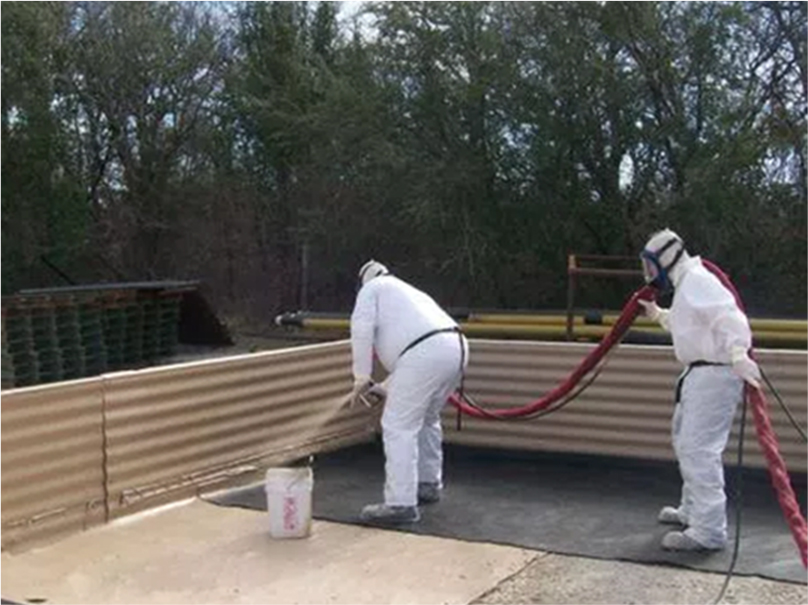
- Bad mixing. A two-part coating that was mixed cold or mis-metered can leave unreacted resin or hardener in the finished film, which is an application problem more than a product problem, and a strong case for professional plural-component spray equipment over a hand-mixed job.
- Plasticizer leaching. Some flexible coatings get their stretch from an additive that can slowly work its way back out over time. Polyurea can achieve flexibility through its polymer structure rather than relying on conventional plasticizers, reducing concern about plasticizer migration.
- Legacy biocide pigments. Older marine coatings sometimes used copper or zinc compounds specifically because they’re toxic to aquatic organisms, which is exactly the opposite of what a closed pond system needs.
- Raw concrete leachate. New concrete is highly alkaline and can harm fish on its own before it’s had time to cure and stabilize. A continuous coating actually solves this by sealing the water off from the concrete entirely.
If any part of the system will also be used for potable water, a genuine third-party certification, most commonly NSF/ANSI 61, needs to be verified in writing for the exact product under consideration. That’s not a box to assume checked, it’s one to confirm before a product gets specified.
Koi Pond Coating vs. Other Lining Options
Most pond owners are really choosing between a handful of approaches: a sprayed coating, a flexible sheet liner, epoxy, a cementitious system, or basic pool paint. Here’s how they stack up on the things that actually matter for a koi pond.
| Option | Seams | Handles Cracking | Fits Rockwork/Curves | Back in Service |
|---|---|---|---|---|
| Spray-applied polyurea coating | None, fully bonded | Excellent, flexes with the concrete | Excellent, no sagging on vertical surfaces | Often about a day |
| Sheet liner (EPDM/RPE) | Multiple, at every seam and fitting | Decent, but a leak can travel under the sheet | Poor, has to be pleated and folded | Immediate |
| Epoxy | Few if done well, but stiff at joints | Poor, cracks with substrate movement | Fair, tends to sag on vertical work | Several days |
| Cementitious | Depends on the substrate holding | Poor to fair | Good on trowel or spray work | Weeks of curing and flushing |
| Pool paint | Thin, no real margin | Very poor | Fair on smooth surfaces only | Days plus flushing |
For a plain rectangular basin with no rockwork or plumbing penetrations, sheet liner is genuinely the budget-friendly answer. Once the design adds a waterfall, a cave, or several fittings, the seam count on a liner climbs fast, and that’s usually where a seamless sprayed coating starts winning on both reliability and total cost.
Why Koi Ponds Are the Toughest Coating Test There Is
Koi ponds are among the more demanding applications for aquatic coatings. A serious koi collection represents years of breeding and real money, the fish live for decades, and the pond runs as a managed biological system, not just a hole full of water. Koi keepers also inspect and drain their ponds more often than most pond owners, so problems get found fast.
Every traditional option has a well-known failure mode in the hobby: liner develops pinhole leaks at the folds, bare concrete leaches lime and cracks, fiberglass blisters at the waterline, pool paint chalks and clouds the filter. A properly applied sprayed coating avoids all of these because it removes the seams and the porosity that cause them in the first place.
One detail specific to koi ponds deserves its own callout: the coating has to support the pond’s biofilter, not fight it. A surface that’s chalking or shedding constantly feeds debris into the filtration system and can disrupt the beneficial bacteria the pond depends on. Just as important, the coating must not be antimicrobial. A “mold and mildew resistant” product marketed for damp environments works directly against the nitrifying bacteria a koi pond needs to function.
Aquatic Coatings Beyond the Koi Pond
The same principles apply to a wider range of water features, with the specific priority shifting by application. Ornamental fountains and shallow basins deal with constant wet-dry cycling at the waterline, which cracks rigid coatings faster than almost anything else. Waterfalls and artificial rockwork need a coating that builds thickness on vertical and overhanging surfaces without running or sagging. Larger features like aquaculture tanks or exhibit pools add public-health and livestock-safety considerations on top of the basic waterproofing question.
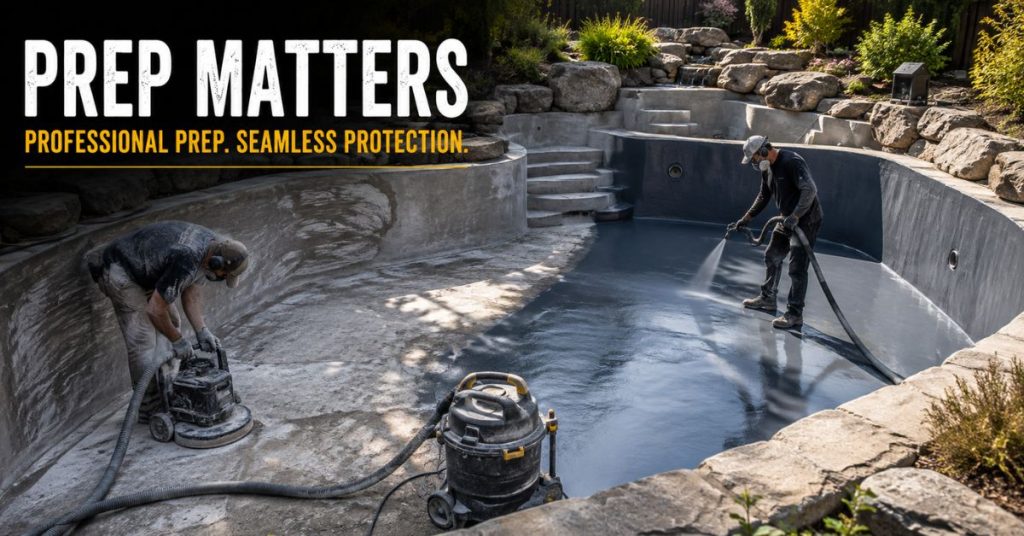
Aquatic Coating Surface Prep: Where Most Koi Pond Coating Failures Start
Coating failures in a pond setting are almost never a product problem. They’re a preparation problem, and it usually comes down to three things.
First, structural issues get addressed before anything gets sprayed. Active leaks, cracked or spalled concrete, and exposed rebar aren’t something a coating fixes on its own, they need repair first.
Second, substrate moisture has to be checked, not assumed. Concrete that looks dry to the eye can still hold enough internal moisture to blister a freshly applied coating from underneath. A calcium chloride test or in-situ humidity probe is a cheap step that prevents an expensive failure.
Third, detailing at transitions decides whether the coating actually holds. Inside corners, drain fittings, and skimmer boxes are where water finds its way through, so coving corners and reinforcing penetrations is worth insisting on from whoever’s doing the work.
If you’re weighing a full pond rebuild versus just relining what’s already there, our foundation waterproofing guide covers a lot of the same substrate and moisture principles that apply here, just for a different structure.
What a Koi Pond Coating Actually Costs
There’s no honest flat price-per-square-foot number for this kind of work, and any quote that leads with one hasn’t actually looked at your pond. Surface prep is usually the biggest line item, especially on a retrofit with existing cracks or a failed old coating. Geometry matters just as much: rockwork, caves, and shelving can easily add well beyond what the flat plan-view area of the pond would suggest, which is why proper quotes are based on wetted surface area rather than water volume. Film thickness and any structural repair needed layer onto that base cost from there.
The more useful way to compare bids is lifecycle cost rather than the first number on the page. A cheap coating redone every few years, each time draining the pond and stressing the fish, often costs more over fifteen or twenty years than a properly installed coating that only needs occasional spot maintenance. For a broader look at where polyurea coatings make sense and where they don’t, our piece on polyurea coating benefits and applications is a useful starting point.
Curing and First Fill After a Koi Pond Coating
The nerve-wracking part of any koi pond coating project is knowing when it’s actually safe to fill the pond and bring the fish back. That depends entirely on how the coating cures. Solvent-based products cure by evaporation, which is slow and hard to verify with confidence. A reactive, high-solids system cures chemically, often essentially complete within hours, which is why a properly applied coating can sometimes be filled the next day rather than after a week or two of waiting.
Even with a fast-curing product, rushing the fill-and-stock sequence is a mistake. A reasonable process looks like: inspect the finished coating for pinholes, fill and hold for a day or two as a leak check, dump that first fill rather than keeping it, refill and bring the filtration online, then introduce fish gradually while monitoring water chemistry. Most fish losses after a pond rebuild trace back to rushing the biological cycle, not the coating itself.
Should You Apply a Koi Pond Coating Yourself?
For a small decorative basin, a confident DIYer with the right prep tools might manage a basic coating job. For an actual koi pond, where the fish are valuable and the margin for error on mixing and metering is thin, professional application with calibrated spray equipment is worth the cost. Our take on DIY versus professional polyurea application goes into more detail on where the line sits.
Frequently Asked Questions
Is polyurea coating safe for koi and other fish?
A properly formulated and fully cured high-solids coating is chemically inert with nothing left to leach into the water. The safety comes from the chemistry being fully reacted and correctly applied, not from what the label says.
How soon can fish go back into a freshly coated pond?
It depends on the specific product’s cure mechanism, but reaction-cured coatings typically allow a faster return than solvent-based ones, often around a day for the coating itself, followed by a proper fill, rinse, and biofilter startup before fish go in.
Is a sprayed coating better than a liner for a koi pond?
For a simple rectangular pond with no rockwork or fittings, liner remains a cost-effective choice. Once the design gets more complex, with waterfalls, caves, or multiple penetrations, a seamless sprayed coating tends to outperform on long-term reliability.
Can an old pond be recoated instead of rebuilt?
Often, yes. A sound concrete or block shell with surface cracking or a failing old coating can usually be prepped and recoated. Existing sheet liner typically has to be removed rather than coated over.
What certification should I look for if the water needs to be potable-safe too?
NSF/ANSI 61 is the relevant third-party certification for potable water contact. It should be verified in writing for the specific product being used, not assumed from general marketing claims.
Conclusion
A koi pond coating is judged by a stricter standard than almost any other coating job, because the water it holds supports something alive and often genuinely valuable. The coatings that hold up best share the same traits: they’re fully inert once cured, they eliminate seams rather than working around them, and they flex with the pond instead of fighting it. Surface preparation, especially checking substrate moisture and detailing the transitions properly, decides the outcome more than which specific product ends up in the sprayer.
Polyurea Reviews Editors
Polyurea Reviews covers polyurea coatings, spray equipment and applications for applicators, buyers and project owners. The site is supported by ArmorThane USA, a polyurea manufacturer founded in 1989.