There’s no shortage of products in the industrial containment space claiming to outperform the competition. Data sheets get passed around, spec numbers get quoted, and marketing language does what marketing language always does — makes everything sound like the best option available. But when a containment mat is sitting on a frozen lease site in February or soaking in diesel runoff under a compressor skid, the only thing that matters is whether the material holds together and does its job.
Polyurea-coated containment mats have gained significant traction across industrial sectors over the past several years, and the claims surrounding them are substantial — longer service life, better chemical resistance, superior cold-weather performance, and reduced lifecycle cost compared to PVC and rubber alternatives. Those are meaningful claims that deserve honest scrutiny rather than blind acceptance.
This review examines what polyurea actually delivers in containment mat applications, where the material genuinely excels, where the limitations exist, and whether the higher price point translates to real-world value for the operations that use them.
The Baseline: What PVC and Rubber Mats Actually Deliver
Any honest evaluation of polyurea containment mats has to start with an accurate picture of what the conventional alternatives do well and where they fall short. PVC and rubber aren’t terrible materials — they’ve been used in containment applications for decades for legitimate reasons.
PVC is inexpensive, widely available, and easy to fabricate into mat configurations with welded seams and reinforced grommets. For light-duty applications in moderate climates with limited chemical exposure, PVC containment mats perform adequately and represent a low upfront investment.
Rubber compounds offer better flexibility and chemical resistance than PVC in many configurations, and they handle moderate temperature ranges reasonably well. Vulcanized rubber mats are heavier and more expensive than PVC, but they hold up better under repeated mechanical stress.
The problems with both materials are well documented and consistent across field reports. PVC loses flexibility over time as plasticizers migrate out of the material, a process accelerated by UV exposure and chemical contact. That progressive stiffening leads to cracking at fold points and seam separation — the two most common failure modes in PVC containment mats. Rubber compounds resist that particular degradation pathway better, but they carry weight penalties, higher cost, and limited resistance to certain hydrocarbon families and solvents.
Neither material was specifically engineered for the combination of mechanical, chemical, and environmental stresses that industrial containment mats encounter in demanding field service. They were adapted for that purpose from other applications, and their limitations reflect that origin.
Where Polyurea Genuinely Outperforms
After reviewing field data, manufacturer specifications, and operator feedback across multiple industrial sectors, several areas emerge where polyurea coatings deliver measurable advantages over conventional containment mat materials.
Cold-temperature performance is the most clear-cut advantage. PVC mats become dangerously stiff at temperatures below -10°C, and many operators in northern climates report cracking failures during winter deployment. Polyurea maintains functional flexibility well below -40°C, which means the mat can be transported, unfolded, and deployed in extreme cold without the coating cracking at fold lines. For operations in northern Alberta, the upper Midwest, or any high-altitude site with severe winters, this property alone can justify the material change. Canadian operators working across the resource sector have reported significantly fewer cold-weather failures after switching to polyurea containment mats, which aligns with the material’s tested low-temperature performance data.
Tear propagation resistance is the second standout property. Polyurea doesn’t just resist initial puncture — it resists the spread of damage from that puncture point under tension. In field conditions where mats sit on gravel, encounter dropped tools, or get dragged across rough surfaces, this property determines whether a small nick becomes a repairable issue or a complete mat failure. ASTM D624 tear testing on polyurea coatings consistently shows superior propagation resistance compared to PVC and most standard elastomeric coatings.
Chemical resistance holds up across a broad range of industrial fluids. Immersion testing and field exposure data confirm that polyurea maintains its dimensional stability and mechanical properties after prolonged contact with diesel, hydraulic fluid, glycol-based products, dilute mineral acids, and caustic solutions. PVC swells and softens noticeably under similar hydrocarbon exposure, which compromises both the coating integrity and the seam bonds.
Elongation and elastic recovery work together to resist fatigue failure. With elongation values commonly exceeding 400%, polyurea absorbs the repeated flex cycles of folding and unfolding without developing the permanent deformation that leads to thinning and eventual cracking at fold points. The elastic recovery characteristic — meaning the coating returns to its original dimensions after stretching — is the key differentiator here. High elongation without good recovery still leads to progressive material thinning over time.
UV stability in aliphatic formulations extends outdoor service life. Mats that sit on open pads or get stored outdoors benefit from aliphatic polyurea’s resistance to UV degradation. Aromatic formulations will amber and may lose some surface properties over extended UV exposure, but even aromatic polyurea generally outlasts PVC under equivalent conditions.
Where the Limitations Exist
No material review is complete without acknowledging the areas where the product falls short or presents challenges, and polyurea containment mats have legitimate limitations that buyers should understand.
Upfront cost is substantially higher than PVC. Depending on the manufacturer, mat size, and specification requirements, polyurea containment mats can cost two to four times more than comparable PVC products. For operations with tight capital budgets or short-duration project needs, that price premium is a real barrier regardless of the lifecycle cost argument.
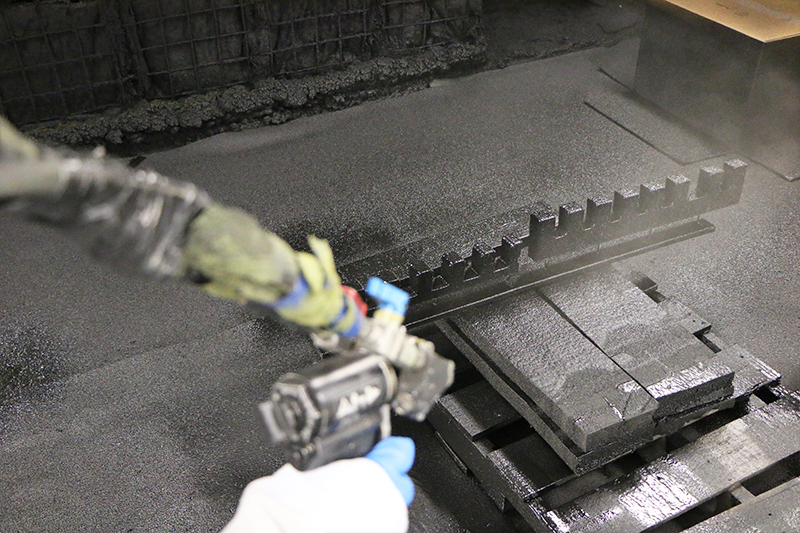
Equipment requirements for field repair are more specialized. While polyurea mats can be repaired in the field, doing so properly requires either portable plural-component spray equipment or cartridge-dispensed polyurea repair kits. PVC mats can be patched with heat welding equipment that’s simpler and more widely available. For operations without access to polyurea repair materials, a damaged mat may need to be sent back to the manufacturer for service.
Quality variation across manufacturers is a real concern. Not all polyurea containment mats are created to the same standard. The formulation, the application quality, the substrate selection, and the seam treatment all affect the finished product’s performance. A poorly applied polyurea coating over an inadequate substrate with weak seam construction will underperform a well-made PVC mat. The polyurea label alone doesn’t guarantee superior performance — the execution behind it matters enormously.
Aromatic versus aliphatic selection affects performance and cost. Aromatic polyurea formulations are less expensive but sacrifice UV stability. Aliphatic formulations maintain UV performance but add cost. Buyers need to understand which formulation they’re getting and whether it matches their deployment conditions. A mat purchased with aromatic polyurea and deployed in constant direct sun may not deliver the UV performance the buyer expected.
The Lifecycle Cost Analysis
The strongest argument for polyurea containment mats isn’t any single material property — it’s the total cost of ownership across the product’s service life.
Field reports and manufacturer data consistently indicate that polyurea containment mats deliver service lives of five to seven years in conditions that require PVC mat replacement every eighteen months to two years. That ratio — roughly three to four PVC replacement cycles per single polyurea mat lifecycle — shifts the economics substantially even before accounting for the ancillary costs of each replacement event.
Every mat replacement involves procurement lead time, shipping costs, site delivery logistics, installation labor, removal and disposal of the failed mat, and a period of reduced or absent containment coverage during the transition. For operations managing containment across multiple sites, those costs multiply with each replacement cycle.
Disposal costs for chemically contaminated mats add another layer. Failed mats that have been in contact with hydrocarbons or regulated chemicals require proper waste handling. Fewer replacement events mean fewer disposal events, which reduces both cost and administrative burden.
The compliance risk dimension is harder to quantify but potentially the most significant. A mat failure during a spill event triggers reporting obligations, investigation procedures, potential remediation costs, and regulatory penalties. The financial exposure from a single containment failure can exceed the cost difference between an entire fleet of polyurea mats and their PVC equivalents.
Application Crossover Worth Noting
The same polyurea chemistry used in containment mat coatings is proving itself across a range of related protective applications. Secondary containment linings, wastewater infrastructure coatings, pipeline protection, and industrial flooring systems all use polyurea formulations that share the same fundamental chemistry and performance characteristics.
One particularly interesting application that demonstrates polyurea’s versatility in containment contexts is its use in bullet containment systems at shooting ranges. The material’s ability to absorb high-energy impact without fracturing or degrading translates well to ballistic environments, and the same tear propagation resistance that protects a spill containment mat from a dropped wrench helps ballistic containment systems manage repeated projectile impacts without catastrophic material failure.
That breadth of application isn’t just a marketing talking point. It reflects a level of real-world testing and performance validation across diverse and demanding conditions that gives buyers additional confidence in the material’s capabilities within containment mat applications.
What to Ask Before Buying
Based on this review, buyers evaluating polyurea containment mats should approach the purchase with specific questions rather than accepting general performance claims at face value.
Request tensile strength, elongation, and tear resistance data tested at temperatures relevant to your operating conditions, not just at standard room temperature. Ask whether the polyurea system is aromatic or aliphatic and understand the implications for your specific deployment environment. Examine the chemical resistance data against the actual fluids your operation handles, not just a generic hydrocarbon resistance rating.
Inspect sample mats for seam quality, coating thickness consistency, and reinforcement at high-stress areas like fold lines and grommet points. Ask about the substrate material and the adhesion system used between the substrate and the polyurea coating — delamination between layers eliminates every advantage the coating provides.
Ask about the manufacturer’s field repair support, including what repair materials and methods they recommend and whether they provide repair kits or portable application equipment for on-site use.
Finally, request references from operations using the mats in conditions similar to yours. Field experience from comparable deployments is the most reliable predictor of how the product will perform in your service environment.
The Verdict
Polyurea containment mats deliver genuine, measurable performance advantages over PVC and rubber alternatives in most demanding industrial applications. The cold-temperature flexibility, tear propagation resistance, chemical resistance, and long-term durability are not marketing exaggerations — they’re supported by material testing data and consistent field experience across multiple industries and climate zones.
The higher upfront cost is real and shouldn’t be minimized, but the lifecycle cost analysis favors polyurea in any application where mats are subjected to harsh conditions, frequent handling, chemical exposure, or extreme temperatures. For operations running under environmental compliance requirements, the reliability advantage carries additional financial weight that the upfront price comparison doesn’t capture.
The caveats are real as well. Quality varies across manufacturers, formulation selection matters, and the polyurea label alone doesn’t guarantee performance. Buyers who do their due diligence — asking the right questions, reviewing relevant test data, and inspecting construction quality — will get what the material is capable of delivering. Those who buy on label alone may not.
For operations that need containment mats to actually work under real field conditions, season after season, polyurea represents the strongest option currently available in the market. The material has earned that assessment through years of field performance, not through superior marketing.